


High Tech Materials in Boat Building
The Pros and Cons of Space Age
Materials in Boat Building
What it Means for the Consumer
by David Pascoe, Marine Surveyor
The boat building industry has entered an unprecedented period of experimentation of new materials for use in the fabrication of what were once called fiberglass hulls. Those of us who have been around the boat building scene for a while have seen a lot o f new ideas and materials come and go over the years. Some have met with success, but most have met with failure, or one way or another have proved unsuitable for building production-line boats.
In this article, we'll take a look at where the industry has been, where it is likely to go, and what effect these changes are likely to have on the end user, the boat owner. We'll look at some questions such as whether the term caveat emptor now more appropriate than ever. After 40 year of fiberglass boat building, is there really a need to take a risk with new, untried materials? Does the use of such exotic new materials really offer the boat owner any real benefits? My answer is no, they usually don't, and I will explain why.
Increasingly, we find a new term being introduced to define what we once called a plain fiberglass hull, "composites." Composite merely means the combination of two or more materials to make a whole. Fiberglass, a combination of plastic resin and glass fibers, is a composite. But, in the marine industry, composite increasingly comes to mean the use of a third material, a core material such as balsa or foam.

Disasters like Hurricane Andrew help surveyors to evaluate new materials and construction methods, putting boats like these to the ultimate test. Here we find out whether the advertising claims meet the tests of reality.
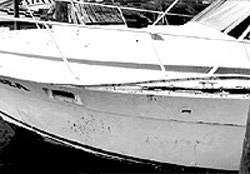
The side of this 42 Bertram took out two 12" diameter wood pilings and crushed another boat without ever breaching the full. The tremendous beating that this boat took proves beyond any doubt the superiority of solid fiberglass laminates.
Boat buyers should be aware of several important points when considering the purchase of a new boat. The first is that new resins, reinforcements and core materials are being developed at an unprecedented rate. Industry magazines and trade shows are promo ting a dizzying array of new materials. Foams laced with plastic and aluminum honeycombs, new arrangements of glass fiber reinforcements in an apparently endless array of new weaves and fiber configurations, plus a wide array of new plastic resins and c hemical additives, are being widely promoted.
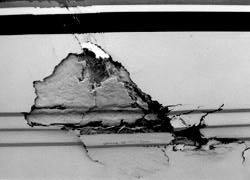
Utilizing a material called CoreMat(TM), this hull fared poorly from contact with a weak 4" x 4" dock piling. The outer laminate is extremely thin (less than 1/8") and had little or no adhesion to the foam. We swung a carpenter's hammer at this hull side with only moderate power and it went right through the hull side.
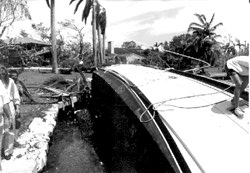
This balsa cored 60' Hatteras hull was subjected to the ultimate test. Not only did it take out two 16" pilings, but look what it did to the concrete sea wall. The outer laminate was breached but the inner laminate remained intact. Compare this wit h the damage caused by a 4" piling in the photo above. The yacht was capsized by 175 MPH winds in the tuna tower, otherwise it would not have sunk.
The second point is that the boat building industry, as a whole, performs very little research and development into the materials it selects and utilizes for hull construction .It is important to understand that proper R & D of a new material is extraordinarily expensive and take as long as 3-5 years to test and prove the application of new materials. Therefore, because of the extreme cost, the past history of the industry has been to try a new material first and ask questions later. Over the years, numerous builders have incorporated untried, untested materials in their product lines, thus making guinea pigs of their customers. And it is this lack of R&D that, in the past, that has been responsible for so many of the hull failures that have plagued the industry.
As long as thirty years ago, the marine industry learned the hard way why it was not a good idea to use balsa cores on hull bottoms. Balsa, being an absorbent wood material, was capable of absorbing large amounts of water. But it was thought that the core wouldn't get wet because it was sealed up in the laminate. Of course, with the advent of the hull blistering problems, we now know that even seemingly solid laminates can absorb water.
That old knowledge seems to have been lost as builders are once again coring hull bottoms, only this time with plastic foam. The idea, apparently, is that foam won't succumb to water absorption and other problems that were encountered with balsa. Materials suppliers claim that because foam has "closed cells" that the material won't absorb water. Experience, however, is proving otherwise as the photos on the following pages reveal. Water ingress into foam cores has proven a common occurrence which, once i t does, can result in very rapid deterioration of hull strength.
While many of these new materials grab center stage attention at trade shows, seminars and in magazine articles, promoting the many virtues, what attracts my attention is the lack of any test data to go along with these new materials. I am reminded of the introduction of closed cell foam back in the early 1980's as the new miracle material for boat builders that was hyped as the ideal material for building boats that were stronger, lighter and less costly to build. Having once worked in a plant that built balsa cored hulls, I was well familiar with the technical data on balsa, including its strengths and weaknesses. What caught my eye, even back then, was that, of those few foam makers or distributors who even bothered to offer spec sheets on their mate rial, virtually all that I had seen had selectively provided only the most complementary data on their product. In other words, they sold the materials strengths while never mentioning its weaknesses. The result was that a few boat builders jumped onto the foam core bandwagon with disastrous results. Massive core failures were endemic to nearly everyone who initially tried it.
Here was a case where builders latched onto a material without even knowing what it is structural properties were. They took the salesman's word and tried the material directly in their product line, without performing their own R&D. When massive hu ll failures resulted, many of these companies folded up because they couldn't meet their customers claims.
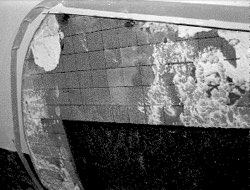
Incomplete bonding of the core to the outer hull is one of the major problems encountered with foam cored hulls. In this case, less than 50% of the core was bonded, resulting in complete delamination of the full. Even where the bonding agent made contact with the core, adhesion was poor to nonexistent.
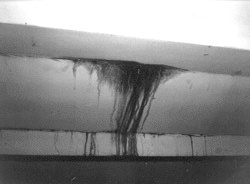
The gunk pouring out of this hull is the result of complete water saturation of the foam core. Hydraulic action - panting of the inner and outer skins - pulverized the foam and turned to black mush. Once the foam degraded, the laminate weakened and split open, sinking the boat.
Many of the larger builders such as Bertram, Hatteras and Viking make a valid attempt at R&D. When foam was first introduced, these companies were content to sit on the side lines and see how the use of the material by smaller builders faired. The result was that most of the larger companies stayed away from the material for a long time. Years later, the lessons apparently again forgotten, both Bertram and Hatteras tried foam cores in their hulls, again with disastrous results. Hatteras ended up recalling one full model line in which they used foam in the hull. Fortunately, they discovered their error after only eight boats were built. Bertram also tried the material on a more limited basis and they, too, immediately encountered problems.
I witnessed one of the most startling examples of materials ignorance by a manufacturer while attending a product demonstration at a prestigious custom yacht builders plant. With the outer skin of the hull freshly laid up, the core material manufacturer proceeded to demonstrate how their new core bonding putty would solve the problem of incomplete bonding of the core to the laminate. They even used a special vibrating machine on the core to ensure that the bonding putty was fully spread out and worked into all the seams of the core. After completing the process, to demonstrate just how thorough the bonding would be, they pulled the freshly applied core away from the laminate. Viola! Only about 70% bonding took place, leaving large areas completely out of contact with the bonding putty, and the demonstrators red-faced.
But the salesmen recovered quickly and told the audience that this was just a demonstration, but that if you do it right, you'll get the right results. The audience was not quite so sanguine. We were left to wonder, if the experts couldn't get it right the first time (after all, it was their product), how were us lesser mortals supposed to do any better?
The answer was, of course, that they couldn't, as the nearby photo testifies to other builder's experience with the product. As it turned out, bonding failures with this product became a regular feature of its application.
Then there was the case of Airex, a widely touted foam whose use came and went as rapidly as the changing of the seasons. Airex was a different type of foam than the typical rigid urethane foams that we usually hear about. Here again, a new material was promoted without R&D. A PVC based material, that is highly sensitive to heat, no one bothered to find out how this material would react to heat. Used on decks that heat up or on hull sides in way of hot engine rooms, Airex foam would soften, resulting in laminate distortion and delamination.
By now, everyone is familiar with the problems of hull blisters. But perhaps you were not aware that for the first twenty years of fiberglass boat construction, very few boats ever encountered the problem. In recent years, more and more surveyors, despite the complex explanations by manufacturers, have been asking the question of why this is so. The answer is astonishingly simple: inferior materials. A high production builder uses millions of pounds of plastic resin annually. If they could reduce the cost of their resin by as little as 10%, they could achieve enormous savings. And that's what they did by using a lower quality resin that significantly cut their materials cost. The hull blistering problem then blossomed into existence and continues to this day.
Back in the late 1970's there were two builders who attempted to use two different types of honeycomb core. Yes, on the hull bottoms. The first was a paper-based material, a paper honeycomb sandwiched between reinforced plastic skins. This material was tried out by the builder of a very expensive 26 foot sport fisherman. It doesn't take much imagination to figure what happened to these boats. Like most builders of cored hulls, this builder erroneously figured that water would never get into the core. A nd when it did, the result was disastrous.
The second new core was an aluminum core. Once sea water got into this foil-thin aluminum honeycomb, the rate of destruction was nearly as fast as with the paper core. Within a few years time, these boats experienced catastrophic bottom panel failure. Now here's the real rub: because the builder was told that the use of the core would make the bottom panels much, much stronger, the builder then chose to greatly reduce the size of the framing system. Thus, when the bottom core failed, the loss of the core strength resulted in the loss of strength of the entire structure. The weak framing system caused the entire bottom structure to fail, whereas had the framing system been up to normal standards the extent of failure would have been far less dramatic th an it was.
If you're contemplating the purchase of a new or used boat, the sort of problems outlined above are exactly the kind of thing you want to avoid. When issues of serious hull problems arise, resolution of the problem is rarely as simple as returning the product to your nearest dealer for a refund. Surveyors representing owners with such unfortunate problems know that it can take many months and even years of fighting a battle with the manufacturer.
Since solid fiberglass hulls have been successfully built for over 40 years now, the question arises as to whether there is really any significant benefit to coring a fiberglass hull. Are cored hulls really stronger and lighter than solid cored hulls? We've all heard the claim that cored hulls are lighter and stronger than solid laminates, but this is not exactly true. Cored laminates are stronger in flat panels, but are weaker when used with curved surfaces. My examination of hundreds of boat hulls damaged by recent hurricanes clearly shows that most cored hulls fared nowhere near as well as solid laminate hulls.
Here's a good example. In one case, an older, solid fiberglass 42' Bertram and a custom built, cored hull 42 footer were docked side by side. The hurricane broke both boats loose and drove them across a bay where they were both badly battered against a concrete embankment along with a group of other boats. Both of these yachts sustained the identical degree of battering. Can you guess which one held up the best? In fact, the cored hull yacht had nearly 50% of its hull destroyed and was sunk. The Bertram, on the other hand, despite an incredible battering, never had its hull breached and survived the storm without sinking.
You might be asking why you should care how well your boat holds up in a hurricane? The answer is that you would care if you were in it when it ran aground or was in a collision with another vessel, deciding the question of whether you and your family would sink or swim. Poorly constructed hulls not only perform poorly in storms, but under more ordinary adverse conditions as well.
A case in point occurred years ago when I smacked my boat into a 12" steel I-beam waterway marker at night. No foam cored hull would have stood up to the impact that my solid fiberglass hull withstood without ripping a hole in the hull. There's no doubt in my mind that me and my friends would have gone swimming that night were we in a foam cored hull.
The fact is that foam cored laminates are extremely vulnerable to impact damage, and are highly prone to core separation. Our examination of balsa cores revealed that they, too, fared much better than foam cores. The advantage of balsa is that it has both superior bonding strength and superior shear strength. Whereas foam is very weak against inter laminar shearing forces, balsa is quite strong. This is easy to understand because we all understand how wood is weak with the grain, but very strong again st the grain.
We have all heard the hype that foam cored panels are stronger than solid laminates. What you may not have heard is that cored panels are only stronger if they are flat! Curved cored panels are decidedly weaker than solid glass panels, particularly when compressive loads are applied in shear mode. Most foam cored panels take very poorly to bending. The "S" shaped reverse curves of the typical sailboat hull is a case in point, and accounts for why so many failures occur in sailboats. Here we see that the shape of the panel has everything to do with the performance of cores.
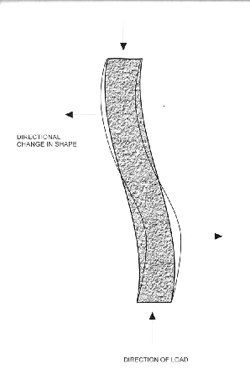
The effect of stress and compression loading on foam cored panel. Bending causes inner and outer skins to creep at different rates due to the difference in the radius, causing the core to shear or separate.
To understand what happens to curved panels, imagine an "S" shaped panel like a sail boat hull section. Now, apply a compressive load on the ends as shown opposite. What happens? Well, the inner and outer laminates bend and creep at different rates, owing to the fact that they have a different radius. This causes a very unexpected shearing force that shears the very weak foam. This, in a nutshell, demonstrates why so many foam core failures occur on curved surfaces as compared to flat panels. The shear strength of the foam is simply inadequate to resist these forces.
What should now be giving us pause for reflection is the fact that both paper, plastic and aluminum cores are once again being marketed to boat builders. Some of these are in different configurations, such as aluminum honey comb embedded in foam. Others consist of open cell molded plastic honeycomb, or foam-filled plastic honeycomb. Such materials are probably fine for use in non-dynamic structures, but how are they going to hold up in a dynamic structure such a boat hull that is constantly immersed in sea water that travels at high speed? Do the builders have the test data to warrant their use? Whenever I ask this question of materials distributors, it is usually met with a blank stare, telling me that they have no idea of the physical characteristic s of the material they're marketing.
The use of such so called "high tech" materials is spreading rapidly in the boat building industry once again and the axiom caveat emptor is now more appropriate than ever. The question we need to ask ourselves is, knowing that good quality fiberglass hulls have been built for over forty years with an excellent track record of success, is there any real need to take a risk with new, untried materials? Does the use of such exotic materials really offer the boat owner any real benefits?
My answer to that is no, they don't. The move to incorporate such materials in boat hulls is primarily an effort to reduce materials cost and produce a cheaper product, one that ultimately poses higher risks of hull failure and produces boats that are les s rugged with a shorter life span. They offer the boat owner no significant benefit, but plenty of extra risk. The most significant risk of the utilization of untested materials in boat construction to the boat owner is the potential for serious hull failures for which the boat owner has difficulty in getting the problem resolved.
Over the years, many builders have gotten themselves into so much trouble using unproven materials and techniques that financially they were unable to fulfill their warranty commitments, went bankrupt and left their customers holding the bag. This is precisely the sort of thing we wish to avoid.
The following are a few tips on how to avoid falling into the trap of purchasing an inferior product.
- Be aware that boat building is a low capital investment manufacturing
business that is easy to enter but hard to prosper in. During the last ten
years, an estimated 80% of all builders went under, most leaving unresolved
warranty claims. If warranties a re important to you, choose your builder
carefully.
- When shopping for new or used boats, beware whenever the price of one
builder's boat, as compared to a group of other similar boats, is
substantially less. Quality is universally a function of price. Whenever the
price of one boat appears to be too goo d to be true, it usually is. Chances
are the reason is low quality.
- Take the time to consider the quality of vessel you wish to purchase.
Today more than ever, boats are designed to appeal to vanity, often at the
expense of quality, safety and resale value. Determine how long you think
you will own the vessel, and what is it likely be worth when it is time to
sell. Remember that lower quality boats deteriorate and depreciate more
rapidly than higher quality boats. Price should not be the only determining
factor.
- Use the top quality builders such as Bertram, Hatteras and Viking as the
benchmark for comparison.
- Once you've decided on the type of boat you're interested in, but before
actually shopping the market, contact one of the surveyors listed on this
page and discuss the various types of boats that you are considering. Our
surveyors are usually familiar w ith the construction of the most popular
builders and they will be happy to share with you their knowledge.
- Once you've determined which particular vessels you are interested in, it is worth a call to the builder to find out whether their hulls and decks are cored and, if so, with what materials.
Experienced boaters are increasingly learning the advantages of having even new boats surveyed. Nobody is perfect and even the best of builders can, and do, make mistakes. A truly professional marine surveyor knows how to evaluate hull construction and pu t a boat through its paces in a rigorous check out regimen, thereby making the outfitting and delivery process as efficient and smooth as possible. A new boat survey accomplishes the following objectives:
- Discover faults and defects prior to taking delivery.
- Saves time and repeat trips to the dealer for warranty repairs.
- Provides the buyer with negotiating leverage that he might not otherwise have without the survey.
- Correct design or engineering mistakes that may not reveal themselves until after the warranty period has elapsed.
|
Related Articles:
|


Over 180
Online Articles by David Pascoe

Power Boat Books
 Mid Size Power Boats
 A Guide for Discriminating Buyers
Focuses exclusively cruiser class generally 30-55 feet
With discussions on the pros and cons of each type: Expresses, trawlers, motor yachts, multi purpose types, sportfishermen and sedan cruisers.

Selecting and Evaluating New and Used Boats
Dedicated for offshore outboard boats
A hard and realistic look at the marine market place and delves into issues of boat quality and durability that most other marine writers are unwilling to touch.

2nd Edition
The Art of Pre-Purchase Survey The very first of its kind, this book provides the essentials that every novice needs to know, as well as a wealth of esoteric details.

Pleasure crafts investigations to court testimony The first and only book of its kind on the subject of investigating pleasure craft casualties and other issues.