


Windows, Windows,
Those Leaky, Leaking Windows
by David Pascoe, Marine Surveyor
Leaking windows are inconvenient because they let the water that is supposed to remain on the outside into places it shouldn't be. Oh, it's aggravating enough that you might have to try to sleep on a wet mattress, but that's hardly the least of your problems when you have a leaky boat. The real kicker is when those leaks cause a lot of damage, as they are wont to do, that cost you a whole lot of money to repair, and even more money when you go to sell the boat if you don't.
Contents
IntroductionDesign Error
Motor yachts and Flybridge cruisers
Express Cruiser
Fixed Windows
Improperly designed side decks
Motor Boat
Sail boats
26 Formula
with 9 photos and 1 Illustration
Introduction
I just saw a good example of that this morning when I surveyed a 10 year old Chris Craft that had about $5,000 worth of interior damage because of just plain lousy design of the windows that caused leaks that couldn't be fixed. This after the survey of a 47 foot Albin trawler last week that had an all wood paneled interior that had about $8,000 worth of water damage, preceded by a 29 foot Formula with an interior that was completely ruined by window leaks, for which the cost to repair would have been well over $10,000. And a week before that I did a 42' sailboat with leaking chain plates that rotted out the bulkheads that they were attached to, causing damage worth at least $15,000. So right there in just two weeks were three boats with water damage estimated at over $38,000, and that does not include the cost of repairing the leaky windows and design defects.
Leaky windows are a serious problem not only because of the costly damage they cause, but also because all too often the source of the problem are design errors which are costly to correct, if they can be corrected at all. Leaky windows are a serious problem because it is such a widespread problem, occurring in top of the line as well as bottom of the line boats. Leaky windows are a problem because if you buy a boat that has them, and the problem cannot be corrected, you are going to take a big bath come time to sell your boat.
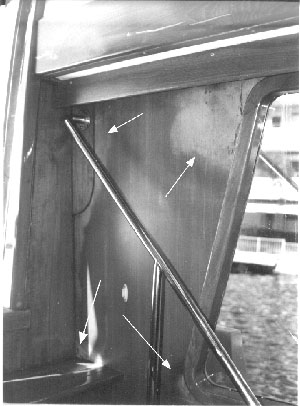
Leaking windows of this Albin 47 resulted in rotted paneling throughout this yacht. it's not easy to capture water damage on film, but this shot pretty well tells the story.
The interior of this boat is completely ruined and the cost to repair so high that it will never be properly repaired because the condition destroyed the value of the boat.
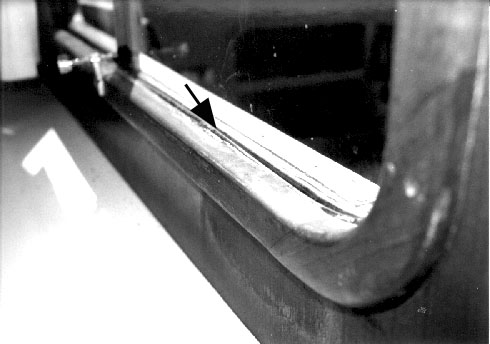
Here's the reason why the interior of the Albin was ruined. The window consists of nothing more than a piece of glass sandwiched between two pieces of wood. To make matters worse, the builder used a sealant that dried hard and brittle which can be seen falling out at point of the black arrow.
Design Error
Pay attention to window leaks because the nature of the problem is likely to be rooted in a serious design error. The correction of window leaks is rarely, repeat, rarely just a matter of caulking. On nearly half the boats I survey I find caulking smeared around the window frames, one of the first signs that all is not well. So why do so many boats have this problem? It's because designers have the idea that it is okay to hold up the cabin top and flying bridge with nothing but the window frames. Unfortunately, that is not okay because the window frames are not strong enough to hold up the deck, cabin top or flying bridge. So when you take the boat out to sea, the whole structure rocks and works and twists and opens up all the seams allowing our number one enemy (water) inside the boat.
To put it another way, essentially what you have is a structure like a fold-up card table on wobbly legs. You can caulk the frames, pull them out and recaulk them, pull out the glass and rebed it, but every time you take the boat out, the window frames are again stressed, all the joints break open and the leaking starts all over again.
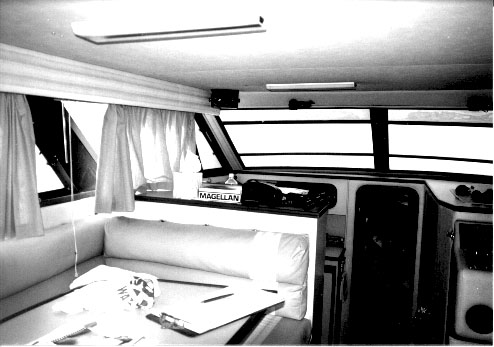
Chris Craft 320. This is what I mean by a house top and flying bridge that is only supported by window frames. Except for the aft bulkhead, the only thing that holds up the bridge with seating for eight people, are the window frames. In this boat, even the galley and head cabinets were rotted from the profuse leakage.
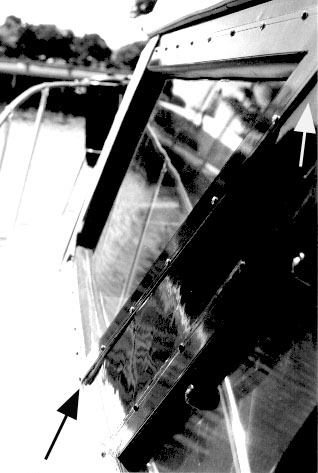
The problem with window problems is that they are hard to diagnose. These photos are the outside views of the Chris Craft interior shown above.
It doesn't look like much is wrong with the window frames until you realize that they are BENT! as can be seen at arrows where the frames are away from the house side.
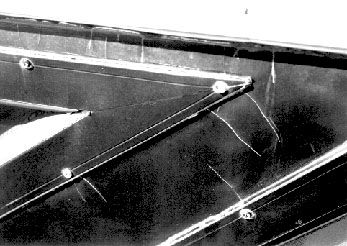
These are not your ordinary stress cracks but cracks caused in the 'glass house sides because there is so much stress on the window frames.
The extremely small screw was used to fasten them didn't help much either, all of which just boils down to shoddy design and construction.
Motor yachts and Flybridge cruisers
Thousands upon thousands of boats are built this way, and the photos I've included here barely scratch the surface of illustrating how bad the problem can be. Motor yachts and flybridge cruisers frequently have nothing but the window frames holding up whatever structure is above them. The problem tends to be more pronounced in midsized flybridge cruisers where there is a lot of weight resting on the window frames, especially those boats with glass front windshields. The problem tends not to exist on those fly bridge cruisers or sport fishermen that do not have front windshields because now the fiberglass front section becomes a stronger structure that resists lateral movement.
Express Cruiser
Leaky windows are also common place in the express cruiser which has no superstructure, where instead long, low windows are set into the side of the foredeck. The next photo shows a Sea Ray with an 8' long window which essentially holds up the fore deck. Lacking any bulkheads or frames beneath, all you have to do is jump down onto the foredeck from a high dock and you will bend and open up the joints in the window frame, and then the leaking starts. On this particular boat, the owner had caulked the sliding windows permanently shut and attached plastic coffer dams under the windows in an effort to keep the water out. Needless to say, it didn't help much. Beware of cruisers with long windows that hold the deck up.
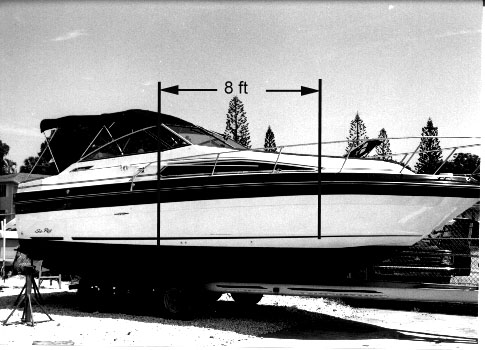
Here's 27' SeaRay with an 8' long window in the side
of the deck. This situation is worse that a house top held up by
window frames because the deck gets walked on, even jumped on.
Most express cruisers have windows like this and nearly
all of them leak. Why is it that they've been building this way for
years without recognising the problem?
Fixed Windows
Another problem are boats with fixed windows not properly installed, or installed without proper frames such as the Albin trawler shown at the top. Here we have large windows that are merely sandwiched between two wood frames. But it's not just the wood that's the problem; the frames could just as well be fiberglass, plastic or aluminum. The manner of the design would fail in any case (because the windows are too large, (2) because the builder used the wrong kind of caulking - it dried out cracked and shrunk, (3) the design was entirely wrong and would leak in any case.
Improperly designed side decks
Yet another design faux pas results from improperly
designed side decks. As illustration #1_ shows, if the side deck is not
properly supported, it will sag, and when it sags the house sides sag with
it. At that point you can see that if the house sides sag . . . well, what
are the window frames attached to? Of course, the sagging house sides.
What happens is that every time the hull slams down off a wave, the whole
deck/superstructure flutters so that no amount of caulking or well
designed window frames can prevent the kind of distortions that open up
seams and cause leaking.
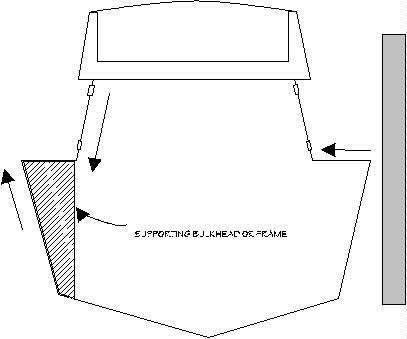
Cross section view of a typical cruiser showing the forces that act on the boats window frames. If the side decks don't have adequate support from the underside, the side decks will flex and open up seams.
Hitting against pilings applies force from another direction that breaks window seals open. If the only thing holding up the flybridge are the window frames, this illustration should make it pretty clear why it will be impossible to prevent leakage.
The bottom line to this story of leaking windows is that leaking windows cannot be prevented, and cannot be repaired, unless the overall structure is properly designed. That includes not just the house structure and window frames but the decks as well. If the side decks are cantilevered inboard without adequate support underneath, then the side decks are going to flex, once again tearing everything open.
Motor Boat
Yet another design faux pas is on a motor boat where there is no house side structure. In other words, the windows span the entire area between deck and house top. What's wrong with this? Well, once again there is inadequate structure to which to attach the frames; the frames are nearly attached to the deck. If the deck sags in the least bit - say just 1/8" - then it should be pretty obvious that that there's no way to keep the working seams sealed.
Sail boats
For sail boats the problems can be just as bad. My favorites are the port holes that trap water, so that when you open the ports, you and everything under it gets a bath. But that's the least of the problem. Inward ports can't trap water that usually results in constant leakage because sooner or later the caulking or gaskets are going to go bad and ruin all that nice paneling around them. Or the vinyl or fabric or carpet or whatever.
Sail boat designers like to save money by not using any window frames at all, just caulk the old glass or Plexiglas right onto the cabin trunk and presto, instant el cheapo window. Not to worry because it probably won't start leaking 'till the warranty expires, after which it's the owner's unsolvable problem. Especially if, as with our motor boats, the deck is weak and flexing, resulting in seals that won't seal no matter what you do. This is even more prevalent with deck hatches because the decks are more likely to flex than the house sides. That's why we find so many vee berth mattresses that are all water stained and rotted out on the bottom. And it explains, too, why chain plates that go through the deck are impossible to seal. Apparently it's Poseidon's Law that you can't seal anything that moves.
26 Formula
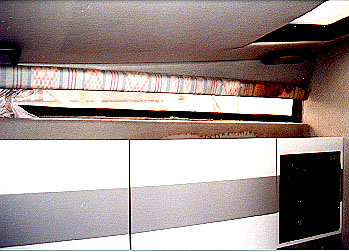
I saved the following photos for last because they're in color and will probably take forever to download. This is the 26 Formula mentioned earlier. It has the same long windows supporting the deck as the SeaRay above, but the water damage is so extensive it shows up on film.
Notice the badly stained upholstered panels or valences above and below the window. Even the hatch (above right) leaked so much that it rotted the furring strips for the headliner which is falling down. Kinda like the headliners in GM cars. Nice work, folks. The interior on this 8 year old boat was completely destroyed by leaks. Walking on the deck of this boat was like walking on a mattress. Ah, well, it's only money. About $70K worth. Never mind that it financially ruined the owner. Why should the good folks at Thunderbird Industries care?
So unless you don't mind throwing your hard earned dollars down the drain, look closely before you leap. The problem of leaky windows is more than merely skin deep. it's usually a sign of a boat that is not well engineered - if it has any engineering at all.
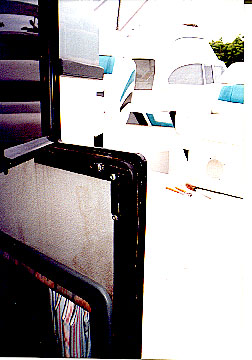
Here's the coup de gras that prompted me to write this article with more than a touch of disdain. What you're looking at here is a TWO PART, INWARD OPENING DOOR on our lovely 26 Formula.
That's right, inward opening. What kind of ignoramus does it take to put an inward opening door on a boat? What kind of fool doesn't know that such a door can't possible keep the water out? If this is the way they do the things that you can see, imagine what the hidden parts are like! If they can't design a door, how's the hull? In a word, BAD.
First posted on October 8, 1997 at David Pascoe's
site: www.yachtsurvey.com.
Page design changed for this site. Some comments that are out
of scope of this site are omitted.


Over 180
Online Articles by David Pascoe

Power Boat Books
 Mid Size Power Boats
 A Guide for Discriminating Buyers
Focuses exclusively cruiser class generally 30-55 feet
With discussions on the pros and cons of each type: Expresses, trawlers, motor yachts, multi purpose types, sportfishermen and sedan cruisers.

Selecting and Evaluating New and Used Boats
Dedicated for offshore outboard boats
A hard and realistic look at the marine market place and delves into issues of boat quality and durability that most other marine writers are unwilling to touch.

2nd Edition
The Art of Pre-Purchase Survey The very first of its kind, this book provides the essentials that every novice needs to know, as well as a wealth of esoteric details.

Pleasure crafts investigations to court testimony The first and only book of its kind on the subject of investigating pleasure craft casualties and other issues.