

Tips on
Electrical System Use and Maintenance
Part IV: Adding New Equipment
by David H. Pascoe, Marine surveyor
Part I - Part II - Part III - Part IVFull Article
Adding New Equipment
Most boats, particularly smaller ones, are unfortunately not designed with the idea of adding equipment, even though nearly everyone does. But the primary reason why systems gets so messed up results from the attempt to force something in where there is no provision for it.
The best way to deal with this is to simply add a new panel, whether AC or DC. Doing this is neither very difficult nor expensive, especially considering the cost to repair all the problems you're likely to create when you try to cram something onto a system not designed to handle it. A six breaker DC panel will cost less than $200 and is a whole lot better than scattering inline fuses all over the place, and with installation will run less than $500. Plus, the new panel can be added at any location where it will be convenient.
Adding a second shore power circuit is especially useful for those boats with single 30 amp shorelines where the addition of new equipment will tax the system. It's not very convenient to have to turn the water heater off to turn the air conditioning on, or constantly be managing equipment as breakers keep popping off. You have two options here, the first of which is to increase your shoreline to 50 amps. To do that you have to change the main breaker, power receptacle and the shore cord, which is a lot bigger and heavier. The other option is to add a second 30 amp circuit, which means adding a new panel, receptacle and shore cord, which costs a bit more.
Adding a second circuit has the advantage of separating the air conditioning onto a separate line, which is the way all good systems are designed. That's because of the high power demand, combined with frequent dock power faults, makes it desirable to separate it from the main service.
Multiplex Systems
A multiplex system is a multiple power source system which permits switching from one line to another, from one power source to another. For travelers, this is extremely useful to deal with unreliable dock power, or sudden faults in your own system. It allows you to choose which line you want to run equipment on, and particularly if you have a generator, it provides a great deal of flexibility. Let's say a circuit breaker on the dock goes out while you're cooking dinner and it's very hot this day. Instead of only being able to turn the AC off and go on cooking in the heat, you can fire up the generator to run the failed circuit simply by switching it over. The better larger boats invariably have this kind of system.
The reason why low cost boats don't have this kind of system is because it requires the use of very expensive rotary switches that costs $300 - $600, plus some more complex wiring. But it is an extremely good system to have. See photo below.
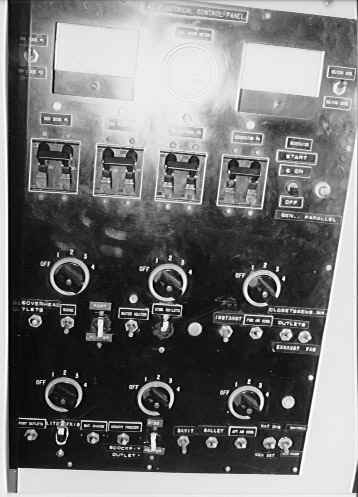
As versatile as it can get. This boat has (2) 125 and (1) 250 shorelines plus generator for a total of 4 power sources. These are controlled by the six rotary switches, each with four positions, so that any combination of power sources on any branch circuit can be selected.
- Part I: Introduction with 2 photos
- Part II: High Voltage (AC) Systems with 0 photos
- Part III: DC Systems with 6 photos
- Part IV: Adding New Equipment with one photo
- Or Full Article
Posted November 15, 1998 (First posted July 14, 1998 at www.yachtsurvey.com. Revised and added two pictures November 02, 1998. Page design changed for this site.)


Over 180
Online Articles by David Pascoe

Power Boat Books
 Mid Size Power Boats
 A Guide for Discriminating Buyers
Focuses exclusively cruiser class generally 30-55 feet
With discussions on the pros and cons of each type: Expresses, trawlers, motor yachts, multi purpose types, sportfishermen and sedan cruisers.
Selecting and Evaluating New and Used Boats
Dedicated for offshore outboard boats
A hard and realistic look at the marine market place and delves into issues of boat quality and durability that most other marine writers are unwilling to touch.

2nd Edition
The Art of Pre-Purchase Survey The very first of its kind, this book provides the essentials that every novice needs to know, as well as a wealth of esoteric details.

Pleasure crafts investigations to court testimony The first and only book of its kind on the subject of investigating pleasure craft casualties and other issues.